About the Journal
e-ISSN : 2579-8561 (online)
Accreditated Sinta-2
Google Scholar ID : 1iyrcGkAAAAJ
The De Jure Legal Research Journal, known as Jurnal Penelitian Hukum De Jure, is a legal publication issued three times a year in March, July, and November. It is published by the Law Policy Strategy Agency of the Ministry of Law of the Republic of Indonesia, in collaboration with the Indonesian Legal Researcher Association (IPHI). This association was legalized under the Decree of the Minister of Law and Human Rights Number AHU-13.AHA.01.07 in 2013, dated January 28, 2013. The journal serves as a platform for communication and a means to publish diverse and relevant legal issues primarily for Indonesian legal researchers and the broader legal community. In 2024, the management of the De Jure Legal Research Journal will include various stakeholders, as outlined in the Decree of the Head of the Law and Human Rights Policy Agency Number PPH-18.LT.04.03 for 2024, dated February 20, 2024, which establishes a publishing team for the journal.
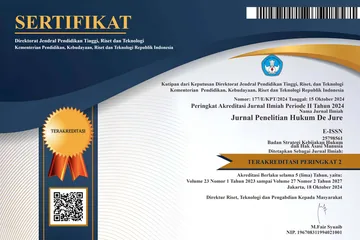
Based on the Decree of the Director General of Higher Education, Research and Technology, Ministry of Higher Education, Science and Technology of the Republic of Indonesia Number 177/E/KPT/2024 concerning the Accreditation Ranking of Scientific Journals Period II of 2024, dated October 15, 2024, the De Jure Legal Research Journal has received a Scientific Journal Accreditation Ranking of Rank 2 (Sinta-2 or S2). This re-accreditation at Rank 2 applies from Volume 23 Number 1 (2023) through Volume 27 Number 4 (2027), covering publications issued during this period.
Current Issue
The November issue of the De Jure Legal Research Journal features five articles addressing various legal issues:
-
Legal liability for works generated by Artificial Intelligence (AI) from the perspective of Indonesian copyright law.
-
The use of AI in supervising Islamic financial institutions, with final decision-making remaining under human control to ensure Sharia compliance.
-
The rescheduling of General and Local Elections following Constitutional Court decisions to safeguard democracy and promote alignment between central and regional development.
-
The application of Besemah customary law as a restorative justice model for resolving criminal cases through customary reconciliation.
-
The reformulation of capital punishment for corruption offenses to ensure legal certainty and alignment with the Indonesian National Criminal Code.
These five articles provide valuable insights into legal studies and may serve as relevant references and sources for citations in future scholarly writing.
Articles
-
Multi-Actor Creator Liability in AI-Generated Works: A Normative Framework for Indonesian Copyright Law
Abstract views: 0
PDF (Indonesian) downloads: 0
PDF downloads: 0 -
Legal Framework for Artificial Intelligence in Sharia Supervision of Islamic Financial Institutions Based on the Human-in-the-Loop Model -
Abstract views: 0
PDF (Indonesian) downloads: 0 -
Reformulation of the Death Penalty for Corruption Offenses in Indonesia: A Neoretentionist Perspective
Abstract views: 0
PDF (Indonesian) downloads: 0 -
Besemah Customary Law as a Living Law in Indonesian Criminal Law Reform from a Restorative Justice Perspective
Abstract views: 0
PDF (Indonesian) downloads: 0